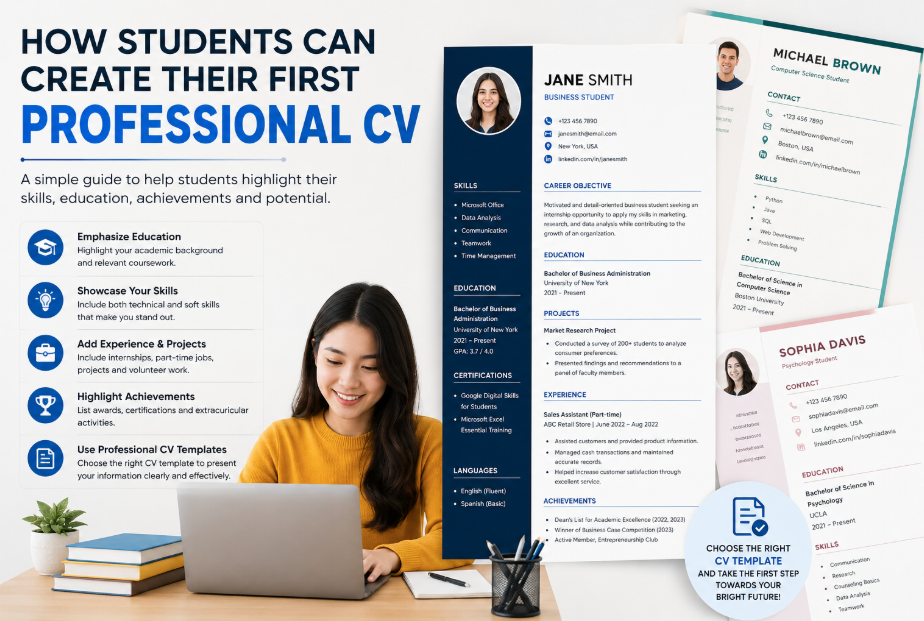
Creating your first professional CV can feel difficult when you are still a student. You may not have years of work experience, a long list of achievements, or advanced professional certifications. But that does not mean you have nothing valuable to include.
A strong student CV is not about pretending to have more experience than you do. It is about presenting your education, skills, projects, volunteer work, leadership roles, and potential in a clear and professional way. Employers, internship coordinators, scholarship boards, and admission teams understand that students are still building experience. What they want to see is effort, ability, organization, and readiness to learn.
This is where well-designed CV Templates can make the process easier. A good CV template gives you a professional structure, helps you organize your information, and ensures your CV looks clean from the beginning. Instead of worrying about layout, spacing, and formatting, you can focus on writing strong content.
In this guide, you will learn how students can create their first professional CV step by step.
What Is a Student CV?
A student CV is a document that summarizes your education, skills, experience, achievements, and activities. It is used when applying for opportunities such as:
- Internships
- Part-time jobs
- Scholarships
- Entry-level roles
- Volunteer positions
- Student leadership roles
- Training programs
- Graduate opportunities
- Academic competitions
Unlike a full professional CV, a student CV usually focuses more on education, skills, school projects, extracurricular activities, and personal achievements. Since many students do not have extensive work history, the goal is to show potential, responsibility, and relevant ability.
See also: Financial Technology Trends
Why Students Need a Professional CV
Many students wait until after graduation before creating a CV, but this is a mistake. A professional CV can help you take advantage of opportunities while you are still studying.
You may need a CV to apply for an internship, join a professional program, get a campus job, apply for a scholarship, or submit your profile for career training. Having a CV ready means you can respond quickly when opportunities appear.
A student CV also helps you understand your own strengths. When you write down your skills, achievements, projects, and activities, you begin to see what makes you valuable. This can help you prepare better for interviews and career conversations.
Start With the Right CV Template
The easiest way to create your first CV is to begin with a clean and professional template. CV Templates help students avoid messy formatting and give the document a polished appearance.
A good student CV template should be:
- Simple and easy to read
- Professionally designed
- Well organized
- Suitable for online applications
- Easy to edit
- Clear in section arrangement
- Not overloaded with colors or graphics
Avoid templates that are too decorative, crowded, or difficult to scan. Your CV should look professional, but the design should not distract from your qualifications.
MyCVCreator provides professional CV Templates that students can use to create clean, structured, and career-ready CVs without starting from scratch.
Choose the Best CV Format for Students
For most students, the best CV format is a skills-focused or education-focused format. This is because your education and abilities may be stronger than your work experience.
A good student CV structure can follow this order:
- Contact Information
- Professional Profile or Career Objective
- Education
- Skills
- Projects
- Work Experience or Internship Experience
- Volunteer Experience
- Leadership and Activities
- Certifications or Training
- Awards and Achievements
- References
You do not need to include every section. Choose the sections that match your background and the opportunity you are applying for.
Add Clear Contact Information
Your CV should begin with your contact details. This section must be simple and accurate because employers need to know how to reach you.
Include:
- Full name
- Phone number
- Professional email address
- City and country
- LinkedIn profile, if available
- Portfolio or personal website, if relevant
Avoid using informal email addresses. For example, instead of using an email like coolstudent123@email.com, use a simple professional format such as firstname.lastname@email.com.
You do not need to include personal details such as marital status, religion, or unnecessary identification numbers unless specifically requested.
Write a Strong Career Objective or Professional Profile
Since students may not have much work experience, a career objective can help introduce your goals and strengths. This section should be short, focused, and relevant to the opportunity.
A weak objective may sound like this:
I am a hardworking student looking for an opportunity to gain experience.
A stronger version would be:
Motivated Business Administration student with strong communication, research, and teamwork skills. Interested in gaining practical experience in marketing, customer service, and business operations while contributing positively to a professional team.
This version is better because it mentions the student’s field, key skills, career interest, and value.
Student CV Objective Example
Detail-oriented Computer Science student with knowledge of HTML, CSS, JavaScript, and basic database management. Passionate about building user-friendly web applications and seeking an internship opportunity to apply technical skills in a real-world environment.
Your objective should match the role you are applying for. If you are applying for a finance internship, focus on analytical skills, accounting knowledge, Excel, and attention to detail. If you are applying for a teaching assistant role, focus on communication, patience, organization, and subject knowledge.
Place Education Near the Top
For students, education is usually one of the strongest sections. Place it near the top of your CV, especially if you do not have much work experience.
Include:
- Name of your school or university
- Course of study
- Degree or qualification
- Expected graduation date, if applicable
- Relevant coursework
- Academic achievements
- GPA or grade, if strong and relevant
Example:
Education
Bachelor of Science in Economics
University of Lagos
Expected Graduation: 2027
Relevant Coursework: Microeconomics, Business Statistics, Financial Accounting, Research Methods
If you are still in secondary school or college, you can include your current level and relevant subjects.
Include Relevant Skills
Your skills section should show what you can do. As a student, you may have developed skills through schoolwork, personal projects, volunteering, group assignments, online courses, or leadership roles.
You can divide your skills into categories:
Technical Skills: Microsoft Excel, Google Docs, PowerPoint, Canva, HTML, CSS, Python
Communication Skills: Public speaking, report writing, presentation, teamwork
Research Skills: Data collection, academic research, analysis, referencing
Professional Skills: Time management, problem-solving, organization, leadership
Do not list skills randomly. Choose skills that match the opportunity. For example, if you are applying for an administrative internship, skills like Microsoft Office, communication, organization, and data entry may be more useful than unrelated hobbies.
Add School Projects and Academic Work
Projects are very useful for students because they show practical ability. Even if you have not worked in a company before, your academic projects can prove that you can research, solve problems, present ideas, and complete tasks.
Example:
Academic Project
Market Research Project on Student Spending Habits
- Conducted a survey of 120 students to understand spending behavior and budgeting challenges.
- Analyzed responses using Microsoft Excel and summarized findings in a class presentation.
- Collaborated with a team of five students to produce a final research report.
This example shows research, teamwork, data analysis, and presentation skills.
Projects can include:
- Class assignments
- Research work
- Final-year projects
- Coding projects
- Design projects
- Business plans
- Presentations
- Group work
- Community projects
The key is to describe what you did and what skills you used.
Include Internship, Part-Time, or Work Experience
If you have any work experience, include it. It does not have to be a full-time corporate job. Part-time work, internships, campus jobs, freelance work, and holiday jobs can all be valuable.
Example:
Sales Assistant
ABC Retail Store
- Assisted customers with product selection and answered basic inquiries.
- Processed daily sales transactions and maintained accurate records.
- Supported stock arrangement and helped keep the store organized.
- Developed communication, customer service, and problem-solving skills.
Even simple work experience can show responsibility, reliability, and professionalism.
If you have no work experience, do not worry. You can focus on education, skills, projects, volunteering, and leadership activities.
Add Volunteer Experience
Volunteer experience can make a student CV stronger. It shows that you are willing to contribute, work with others, and take responsibility.
Example:
Volunteer Tutor
Community Learning Program
- Helped secondary school students improve their understanding of English and Mathematics.
- Prepared simple learning materials and supported students during study sessions.
- Built communication, patience, leadership, and mentoring skills.
Volunteer experience is especially useful when applying for scholarships, nonprofit roles, teaching roles, social work opportunities, and community programs.
Highlight Leadership and Extracurricular Activities
Student leadership roles can show employers that you are responsible and active. These experiences can come from school clubs, societies, sports teams, student unions, religious groups, debate clubs, or community organizations.
Examples include:
- Class representative
- Club president
- Team captain
- Event organizer
- Debate team member
- Student ambassador
- Departmental association member
Example:
Public Relations Officer
Business Students Association
- Supported communication between students and association executives.
- Helped promote academic events through social media and class announcements.
- Assisted in organizing student seminars and networking sessions.
This kind of experience can show communication, teamwork, planning, and leadership skills.
Include Certifications and Online Courses
Online learning can help students improve their CV. If you have completed relevant courses, add them to your CV.
Examples:
- Google Digital Skills
- Microsoft Excel training
- Project management course
- Coding bootcamp
- Customer service training
- Data analysis course
- Graphic design course
- Digital marketing course
Example:
Certifications
Introduction to Digital Marketing — Google Digital Skills
Microsoft Excel for Beginners — Online Course
Basic Web Development — Online Training Program
Only include courses that are relevant or useful for the opportunity you want.
Add Achievements and Awards
Achievements help your CV stand out. These can be academic, leadership, sports, creative, or community-based.
Examples:
- Best graduating student in a subject
- Scholarship award
- Debate competition winner
- Sports award
- Leadership recognition
- High academic performance
- Published article or research
- Successful event organization
Example:
Awards and Achievements
- Awarded departmental scholarship for strong academic performance.
- Led a student team that won second place in a business idea competition.
- Recognized as class representative for excellent communication and coordination.
Achievements show that you are active and capable of producing results.
Use Action Words
Action words make your CV stronger. Instead of saying “helped” or “was involved in,” use stronger verbs that show what you did.
Examples of good action words include:
- Organized
- Created
- Assisted
- Researched
- Presented
- Designed
- Managed
- Supported
- Coordinated
- Improved
- Developed
- Led
- Prepared
- Analyzed
For example, instead of writing:
I was part of a group presentation.
Write:
Presented research findings with a team of four students and contributed to the final report.
This sounds more professional and specific.
Keep Your CV Clear and Short
A student CV should usually be one page, especially if you are applying for internships, entry-level roles, or part-time jobs. If you have more experience, projects, and achievements, two pages may be acceptable.
To keep your CV clean:
- Use short bullet points
- Avoid long paragraphs
- Use consistent formatting
- Keep spacing neat
- Remove irrelevant information
- Check spelling and grammar
- Use simple professional language
Your CV should be easy to read within a few minutes.
Avoid Common Student CV Mistakes
Many students make mistakes that weaken their CV. Avoid these:
- Using an unprofessional email address
- Adding too many personal details
- Writing a vague career objective
- Using poor formatting
- Listing skills without proof
- Leaving out projects and activities
- Making spelling errors
- Using one CV for every opportunity
- Exaggerating experience
- Choosing a template that is too decorative
A professional CV should be honest, clear, and targeted.
Tailor Your CV for Each Opportunity
Do not send the exact same CV to every employer or program. Each opportunity has different requirements, so your CV should match the role.
Before applying, read the job description or opportunity details carefully. Look for important skills, responsibilities, and qualifications. Then adjust your CV to highlight your most relevant experience.
For example, if you are applying for a marketing internship, emphasize communication, social media, content writing, research, and campaign-related projects. If you are applying for a software development internship, emphasize programming skills, technical projects, GitHub, and problem-solving.
Tailoring your CV shows that you understand the opportunity and have made an effort to present yourself properly.
Simple Student CV Template
Here is a simple structure students can follow:
Full Name
Phone Number | Email Address | Location | LinkedIn or Portfolio
Career Objective
A short statement about your field, strengths, and career goal.
Education
School or University Name
Course or Degree
Expected Graduation Date
Relevant Coursework or Academic Achievements
Skills
List relevant technical, communication, research, and professional skills.
Projects
Project Title
Brief description of what you did, tools used, and results achieved.
Experience
Job Title or Internship Role
Organization Name
Dates
- Describe your responsibilities and achievements.
- Use action words and measurable results where possible.
Volunteer Experience
Role
Organization Name
- Explain your contribution and skills developed.
Leadership and Activities
Club, society, or student organization role.
Certifications
Relevant courses, training, or certificates.
Awards and Achievements
Academic, leadership, or personal achievements.
This format is simple, professional, and easy to edit using CV Templates.
Why CV Templates Help Students
Using CV Templates can save time and improve the quality of your CV. Many students struggle because they do not know where to place information or how to format the document. A template solves that problem by giving you a ready-made structure.
Good CV Templates help students:
- Organize information clearly
- Create a professional layout
- Avoid formatting mistakes
- Save time
- Present skills and education properly
- Build confidence when applying
With MyCVCreator, students can choose from professional CV Templates, add their information, customize their CV, and create a polished document for internships, jobs, scholarships, and other opportunities.
Final Thoughts
Creating your first professional CV as a student is an important step toward building your career. You do not need years of work experience to create a strong CV. You need a clear structure, honest information, relevant skills, and a professional presentation.
Start with your education, add your skills, include projects, mention volunteer work, highlight leadership experience, and use strong action words. Then choose clean CV Templates that make your document look professional and easy to read.
Your first CV may not be perfect, but it should show your potential. With the right approach and the right tools, you can create a CV that helps you apply confidently for internships, scholarships, part-time jobs, and entry-level opportunities.
MyCVCreator makes the process easier by helping students create professional CVs using ready-made CV Templates designed for clarity, confidence, and career growth.